Posts

Reading prompts for the class of December 13

Image
Please read at least the preface, and Eirin Moure's "transelations" of Fernando Pessoa's heteronym, Alberto Caeiro (a "heteronym" of the Portuguese modernist poet Fernando Pessoa), and especially poem I (although the others are fine too :)).  For the non-Portuguese speakers, perhaps you can have "more faithful" (?) glimpses of the "original (?) here:  https://books.google.pt/books?id=gzHZDwAAQBAJ&printsec=frontcover&hl=pt-PT&source=gbs_ge_summary_r&cad=0#v=onepage&q&f=false   Answer to one or more of these questions.  1. In what ways may we consider  Sheep's Vigil  as revising Alberto Caeiro's staging of "the pastoral"?  2. How can we view this process from the angle of an ecofeminist critique, and/or of "topopoetics" (see Tim Creswell's essay, on moodle) ? 3. Consider the following quotation and speculate how it might relate to MourĂ©'s trans-e-lations of Alberto Caeiro / Fernando Pes...

Reading prompts for December 6

Image
 Comment on the poems of Juliana Spahr, Evelyn Reilly and/or Brenda Hillman having in mind one (or both) of these topics 1. modes and forms of relation with the atmosphere present in them; types of atmospheres; ideas about air and relations between humans and other organisms and inorganic agents in air that the poems work with 2.  practices of activism, or ecopoetics as activist practice.

Reading prompts for November 29 - Rankine, Reilly, Retallack

Image
  Choose either (or both), 1.  "Languages of description may need to change under pressure of new angles of inquiry into how complex interrelationships make sense. (And vice versa as well.)" Comment on this sentence of "What is Experimental Poetry & Why do We Need It?" by Joan Retallack, in light of either Claudia Rankine's or Evelyn Reilly's poems 1. Listen to the beginning of this video where Evelyn Reilly reads from  Styrofoam . In what ways does Evelyn Reilly's online performance - or, aleternatively, Claudia Rankine's "situation videos" (see previous post) - help you understand these poems better?

Reading prompts for November 22: new "lyric" / refunding mythopoesis - native and decolonial writings

Image
 Choose one and try out your ideas in writing: 1. Do some research on mythopoetics and comment on how Chabitnoy and/or Joy Harjo weave myth into their contemporary poetry and what it does for the undecidability of water and environmental or social justice.  2. Close-read any of the following poems by Chabitnoy: "Anatomy of a Wave", "Kingugturningaitua", or "Red Bed Fatale".  2. Watch the following  situation video ( by the poet Claudia Rankine and her partner, the documentary photographer John Lucas), whose text is actually taken from Citizen (though not from any of your excerpts). Considering that two of Rankine's poetry collections are subtitled "An American Lyric", do you see rifts and evolutions here in the concept of "lyric" that tie in with V. Jackson's overview in her academic entry for "Lyric"?

Reading prompts for the class of November 15

Image
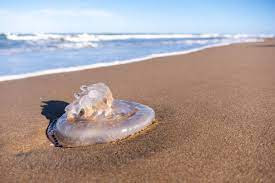
 Comment on whichever you like (or on something besides :)) 1. Provide an analysis / interpretation of Marianne Moore's "A Jelly-Fish" or Adrienne Rich's "Shattered Head". 2. Consider this short poem by Sophia de Mello Breyner Andresen: CORAL It came and went Asking each thing What their name meant or, in Portuguese: "Ia e vinha / Perguntando a cada coisa / Que nome tinha" and relate the lines with either "A Grave" (by Moore) or "The Sea is History" (by Walcott) and their efforts towards looking at names, actions and beings through different angles/directions. 3. In which ways do these poems explore marginal / submerged forms (think of the "awakened dead2 in Adrienne Rich's essay) and how can there relate to a more ecologic deployment of language (or of environmental justice)?

Reading prompts for the class of November 8 (by Professor Diana V. Almeida)

Image
Comment on one or more prompts (on "fish(y)" poems by Moore, Bishop, Oliver, Harjo, and LimĂ³n)  (illustration by a student of Ms. Caitlyn Trimble, that your teacher found in the infamous platform X:  https://x.com/MsTrimbleEng/status/991844239607648256/photo/4 ) Do you fish? Do you keep / cook and eat / talk to fish? What do you know about (old and contemporary) fish? How do these fish swim around from one text to the other? Could the relationship to these fish be determined by the authors’ gender? Can you think about a music and a work of visual art relating to fish / the ocean / water? How do they help you to read these texts?

Reading prompts for the class of October 25

Image
  1. Sometimes, by taking up the problems of the Other, it is possible to find oneself. (..). That is very much the image of the rhizome, prompting the knowledge that identity is no longer completely within the root but also in Relation. Because the thought of errantry is also the thought of what is relative, the thing relayed as well as the thing related. The thought of errantry is a poetics…The tale of errantry is the tale of Relation  (Edouard Glissan, Poetics of Relation , trans. Betsy Wing, 1997 [1990],   18) Both Sylvia Plath's "The Elm" and Adrienne Rich's "Shattered Head" are complicated poems. They seem to aim at reaching "an-other's language", or speaking "through the other", but they also preclude the possibility of easy/direct relations. In what ways does the use of language in these poems thwart identitary representation? What effort do they place on the reader? 2.   How can Steve Mentz's theoretical approach to the O...

Reading prompts for October 18 - Dickinson and Plath

Image
  Choose one (or more, if you really feel like it :))  1. Provide a literary text analysis (slow reading / close reading) of Dickinson's poem "Before I got my eye put out". 2. Compare the relations of writing (forms), nature, and possibly womanhood, in Dickinson's "The Mushroom is the Elf of Plants" and Sylvia Plath's "Mushrooms". 3. Can you relate, either critically or creatively, any of the poems you read with Val Plumwood's discussion of "ecofeminsms"? (image by former student Laura Strazzabosco for Sylvia Plath's poem, "Mushrooms")

For the Class of October 4 - text analysis | close reading practice

Image
 Choose either, to analyse using all the literary, discourse analysis and intertextual skills that you can resort to: 1.   Thoreau, excerpt from Walden (again):  Write a short text analysis of the passage, on pp. 2127-28, that begins "The whole bank, which is from twenty to forty feet high" and ends with "we may turn over a new leaf at last" 2. Whtiman, preface from Leaves of Grass (1855):   pp. 2734-2735: From the paragraph that starts "The art of art" to the end of next paragraph "and makes one" Thoreau, illustration from The New Yorker Whitman, in the opening page of Leaves of Grass  (1855)

For the class of September 27th: The Environmental Imagination of Thoreau's Walden (and Emerson's Nature)

Image
 These are the reading prompts for you to comment on the texts for this week (with lovely pic of Margarida in Walden pond at the bottom!). You can choose one of the questions, or weave more than one into a commentary. 1.Compare Gary Snyder's "Wave" with Thoreau's "Walden" (poem). Which of them seems more eccentric? Why? 2.  Lawrence Buell, in the intro to  The Environmental Imagination  (1999), refers to "literature's capacity for articulating the non-human environment" (10). Do Emerson and (or) Thoreau achieve these goals? In what (different) ways? 3.. Buell also posits, in pp. 7-8, four ingredients that should comprise the more ecocentric texts... Can you pick up from the  Walden  excerpts parts that exemplify such ingredients, and briefly analyse them? 4. Write a short text analysis of the passage, on pp. 2127-28, that begins "The whole bank, which is from twenty to forty feet high" and ends with "we may turn over a new leaf a...

Welcome to this course (Topics on North-American Studies: Ecopoetics of Alterity / Forms of Environmental Justice

Image
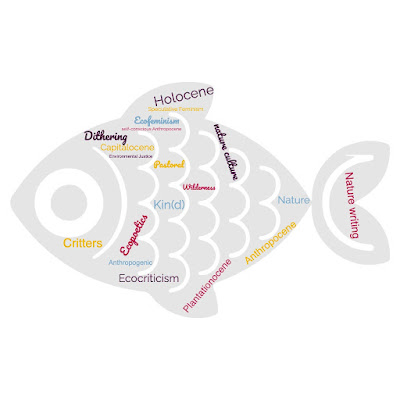
  We will study ecology, poetics, others, and kin(d), and more... For now, as you read Donna Haraway's "Anthropocene, Capitalocene, Plantationocene, Chthulucene: Making Kin" (2015), start researching, and (dis)entangling some concepts! Also, take 13 min to watch  this video  . The first writing prompt, as this is a processual course, is for you to dare share some of your notes (marginalia to Haraway's text or/and your impressions on the video), using the comment box,  in order to kickstart a class discussion.

Reading prompts for November 23

Image
 Choose either (or both), 1.  "Languages of description may need to change under pressure of new angles of inquiry into how complex interrelationships make sense. (And vice versa as well.)" Comment on this sentence of "What is Experimental Poetry & Why do We Need It?" by Joan Retallack, in light of either Claudia Rankine's or Evelyn Reilly's poems 1. Listen to the beginning of this video where Evelyn Reilly reads from  Styrofoam . In what ways does Evelyn Reilly's online performance - or, aleternatively, Claudia Rankine's "situation videos" (see previous post) - help you understand these poems better?

Final Paper Guidelines

 The objective of this final project is to write/prepare a paper that can be presented at a real conference, whether or not you actually submit it. The limit for MA students is 3000 words max , excluding bibliography (this is also the max. for a 20 min. paper). I have been browsing through upcoming conferences related to our topics, but you can also suggest another one that you may find interesting (not necessarily with an explicit ecopoetic angle, but where you might fit in some of our seminar contents, and also perhaps combine them with your upcoming dissertation plan). One good place to start would be the AssociaĂ§Ă£o de Estudos Anglo-Portugueses, thought their upcoming conference is not yet announced (I hope it will be in a few days, they have other good conference tips though): https://apeaa.pt/ Some Eco-humanities-conferences going on: - Narratives of Water:  https://environmentalhumanitieslarca.wordpress.com/2023/11/09/cfp-narratives-of-water-flows-routes-crises-in-...

Tea Jakovina's visualizations of "The Conqueror Worm"

Image
 

Kwame Dawes in our class, and beyond

Image
 

For the Class of October 12th - Whitman and Poe

Image
 1. For this class, we will continue reading the preface from Walt Whitman's  Leaves of Grass  (1855) - please, try your hand at reading closely and affectively this excerpt: pp. 2734-2735: From the paragraph that starts "The art of art" to the end of next paragraph "and makes one"                                               Andrew Wyeth, "Christina's World" (1948) 2. For a poem or excerpt analysis, either in the above prompt or in the following (poems by Edgar Allan Poe), please consider the following guidelines of a close (and affective) reading: pay attention to tone, prosody, semantic networks, significance/effect of rhetoric devices - that is, language - but also, how language makes it thrust at the world and gets entangled with it, for instance: what nature language conceives and how it conceives it?  If you care more for any of the followin...

For the class of October 12th - Whitman and Poe

Image
1. For this class, we will continue reading the preface from Walt Whitman's Leaves of Grass (1855) - please, try your hand at reading closely and affectively this excerpt: pp. 2734-2735: From the paragraph that starts "The art of art" to the end of next paragraph "and makes one"                                               Andrew Wyeth, "Christina's World" (1948) 2. For a poem or excerpt analysis, either in the above prompt or in the following (poems by Edgar Allan Poe), please consider the following guidelines of a close (and affective) reading: pay attention to tone, prosody, semantic networks, significance/effect of rhetoric devices - that is, language - but also, how language makes it thrust at the world and gets entangled with it, for instance: what nature language conceives and how it conceives it?  If you care more for any of the following poems by Edgar A...

For the Class of September 21st: the Environmental Imagination of Thoreau's Walden (and Emerson's Nature)

Image
  These are the reading prompts for you to comment on the texts for this week (with lovely pic of Margarida in Walden pond at the bottom!). You can choose one of the questions, or weave more than one into a commentary. 1. Lawrence Buell, in the intro to  The Environmental Imagination  (1999), refers to "literature's capacity for articulating the non-human environment" (10). Do Emerson and (or) Thoreau achieve these goals? In what (different) ways? 2. Buell also posits, in pp. 7-8, four ingredients that should comprise the more ecocentric texts... Can you pick up from the  Walden  excerpts parts that exemplify such ingredients, and briefly analyse them? 3. Write a short text analysis of the passage, on pp. 2127-28, that begins "The whole bank, which is from twenty to forty feet high" and ends with "we may turn over a new leaf at last".

For the class of November 24 - Eirin Moure, Sheep's Vigil by a Fervent Person (2001)

Image
  Answer to either of these questions.  1. Consider the following two quotations, and speculate on how either, or both, relate to MourĂ©'s trans-e-lations of Alberto Caeiro / Fernando Pessoa, exemplifying with literary analysis from  Sheep's Vigil. "What we sometimes sense in the other side of the expected linguistic engineering of literary translating are imaginings of ‘source selves’ and recordings of translators as they write: we have perhaps an uneasy mix of the biographer and autobiographer in literary translation who are not merely replacing one language with another but cannot help trying to inhabit authorial subjectivities as they strive to internalize and preserve the textua...

What is plastic? (a poem by Sofia Castro Teixeira)

A child said What is plastic? walking along the beach and fetching it to me with full hands; How could I answer the child? I do not know what it is any more than she.   I guess it has become the flag of human disposition, out of colorful polymers woven.   If the handkerchief of Nature is green, they melt and merge to return to black, The sight of crude oil, Branding the owner’s name on the wings of sea birds, pelicans and gulls, on the slippery slick smooth bellies of dolphins and whales, shifting and sticking as they writhe in the water, penetrating and spilling into the very act of breathing. Branding the owner’s name into the corners, the crevices under a turtle’s shell, so that they may wash ashore, and we may say, whose? referring to the guilt.     Or I guess it is a popsicle stick, or a soda bottle, a mid-afternoon snack, a toothbrush,   Or I guess it is a uniform hieroglyphic, And if hieroglyphics tell simply by existing...