Posts

Reading prompts for the class of October 25

Image
  1. Sometimes, by taking up the problems of the Other, it is possible to find oneself. (..). That is very much the image of the rhizome, prompting the knowledge that identity is no longer completely within the root but also in Relation. Because the thought of errantry is also the thought of what is relative, the thing relayed as well as the thing related. The thought of errantry is a poetics…The tale of errantry is the tale of Relation  (Edouard Glissan, Poetics of Relation , trans. Betsy Wing, 1997 [1990],   18) Both Sylvia Plath's "The Elm" and Adrienne Rich's "Shattered Head" are complicated poems. They seem to aim at reaching "an-other's language", or speaking "through the other", but they also preclude the possibility of easy/direct relations. In what ways does the use of language in these poems thwart identitary representation? What effort do they place on the reader? 2.   How can Steve Mentz's theoretical approach to the O...

Reading prompts for October 18 - Dickinson and Plath

Image
  Choose one (or more, if you really feel like it :))  1. Provide a literary text analysis (slow reading / close reading) of Dickinson's poem "Before I got my eye put out". 2. Compare the relations of writing (forms), nature, and possibly womanhood, in Dickinson's "The Mushroom is the Elf of Plants" and Sylvia Plath's "Mushrooms". 3. Can you relate, either critically or creatively, any of the poems you read with Val Plumwood's discussion of "ecofeminsms"? (image by former student Laura Strazzabosco for Sylvia Plath's poem, "Mushrooms")

For the Class of October 4 - text analysis | close reading practice

Image
 Choose either, to analyse using all the literary, discourse analysis and intertextual skills that you can resort to: 1.   Thoreau, excerpt from Walden (again):  Write a short text analysis of the passage, on pp. 2127-28, that begins "The whole bank, which is from twenty to forty feet high" and ends with "we may turn over a new leaf at last" 2. Whtiman, preface from Leaves of Grass (1855):   pp. 2734-2735: From the paragraph that starts "The art of art" to the end of next paragraph "and makes one" Thoreau, illustration from The New Yorker Whitman, in the opening page of Leaves of Grass  (1855)

For the class of September 27th: The Environmental Imagination of Thoreau's Walden (and Emerson's Nature)

Image
 These are the reading prompts for you to comment on the texts for this week (with lovely pic of Margarida in Walden pond at the bottom!). You can choose one of the questions, or weave more than one into a commentary. 1.Compare Gary Snyder's "Wave" with Thoreau's "Walden" (poem). Which of them seems more eccentric? Why? 2.  Lawrence Buell, in the intro to  The Environmental Imagination  (1999), refers to "literature's capacity for articulating the non-human environment" (10). Do Emerson and (or) Thoreau achieve these goals? In what (different) ways? 3.. Buell also posits, in pp. 7-8, four ingredients that should comprise the more ecocentric texts... Can you pick up from the  Walden  excerpts parts that exemplify such ingredients, and briefly analyse them? 4. Write a short text analysis of the passage, on pp. 2127-28, that begins "The whole bank, which is from twenty to forty feet high" and ends with "we may turn over a new leaf a...

Welcome to this course (Topics on North-American Studies: Ecopoetics of Alterity / Forms of Environmental Justice

Image
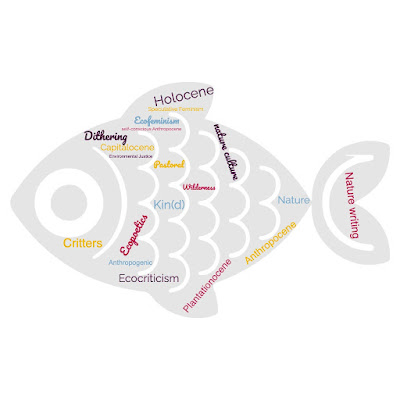
  We will study ecology, poetics, others, and kin(d), and more... For now, as you read Donna Haraway's "Anthropocene, Capitalocene, Plantationocene, Chthulucene: Making Kin" (2015), start researching, and (dis)entangling some concepts! Also, take 13 min to watch  this video  . The first writing prompt, as this is a processual course, is for you to dare share some of your notes (marginalia to Haraway's text or/and your impressions on the video), using the comment box,  in order to kickstart a class discussion.

Reading prompts for November 23

Image
 Choose either (or both), 1.  "Languages of description may need to change under pressure of new angles of inquiry into how complex interrelationships make sense. (And vice versa as well.)" Comment on this sentence of "What is Experimental Poetry & Why do We Need It?" by Joan Retallack, in light of either Claudia Rankine's or Evelyn Reilly's poems 1. Listen to the beginning of this video where Evelyn Reilly reads from  Styrofoam . In what ways does Evelyn Reilly's online performance - or, aleternatively, Claudia Rankine's "situation videos" (see previous post) - help you understand these poems better?

Final Paper Guidelines

 The objective of this final project is to write/prepare a paper that can be presented at a real conference, whether or not you actually submit it. The limit for MA students is 3000 words max , excluding bibliography (this is also the max. for a 20 min. paper). I have been browsing through upcoming conferences related to our topics, but you can also suggest another one that you may find interesting (not necessarily with an explicit ecopoetic angle, but where you might fit in some of our seminar contents, and also perhaps combine them with your upcoming dissertation plan). One good place to start would be the Associação de Estudos Anglo-Portugueses, thought their upcoming conference is not yet announced (I hope it will be in a few days, they have other good conference tips though): https://apeaa.pt/ Some Eco-humanities-conferences going on: - Narratives of Water:  https://environmentalhumanitieslarca.wordpress.com/2023/11/09/cfp-narratives-of-water-flows-routes-crises-in-...